Higher Exercise Intensities May Stabilize Parkinson’s Disease



Parkinson’s disease is the fastest-growing neurological disorder worldwide. In 2021, about 12 million people were living with it and projections suggest that number will more than double in the next 15 years.1 Parkinson's disease is not only increasing in older adults but also rising among younger people, with early-onset cases under age 50 now making up 10 percent of diagnoses.2
At its core, Parkinson’s is a movement disorder caused by the loss of dopamine-releasing neurons in the brain. Dopamine release is crucial for initiating movement in a coordinated manner,3 so the loss of dopamine in Parkinson’s leads to difficulty initiating and maintaining smooth movements. While there is no cure, hope is on the horizon because new research indicates that structured exercise protects against the loss of these neurons, helping people with Parkinson’s regain dopamine signaling so they can move with more control and confidence.4,5
High Intensity Exercise
Low intensity workouts have their place as part of active recovery or stress relief, yet higher exercise intensities deliver more reliable benefits for people living with Parkinson’s. For instance, studies in people with early Parkinson’s reveal that six months of high intensity exercise may reverse the loss of dopamine signaling.4 This highlights a new brain health advantage of interval training for the dopamine system itself, helping people to maintain strong and steady movements.4
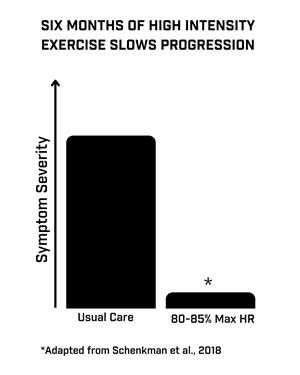
Clinical Trials That Inform Programming
A phase 2 randomized trial found that high intensity treadmill intervals performed four times per week for six months were safe, feasible and more effective than moderate intensity training for improving motor symptoms in people with Parkinson’s.5 Another six-month exercise intervention found that low intensity stretching three times per week did not improve symptoms, while high intensity intervals on a recumbent cycle performed at the same frequency and duration led to significant motor improvements.6 Taken together, these findings demonstrate that higher-intensity workouts are more effective than moderate or low-intensity for easing Parkinson’s symptoms.
Beyond symptom relief, research shows that high-intensity cycling three times a week for six months helps to strengthen brain networks and slows brain shrinkage in people with Parkinson’s.7 This means that higher-intensity cardio can do more than ease symptoms. As experts on this topic emphasize, exercise seems to “stabilize disease progression” while improving the size and structure of the brain.7
Mechanisms Clients Can Feel
While the research involves months of consistent workouts, even a single vigorous workout can boost dopamine release in the brain, which helps people with Parkinson’s move and feel better right away. And as workouts become more consistent, symptoms continue to improve. This is because the full suite of therapeutic benefits takes repeated efforts over several months for the brain circuits to improve and for increased dopamine signaling.8

What To Program Now
Personal trainers may use these findings to justify two to three higher intensity cardio sessions each week, scaled to each member’s comfort and safety.5 With time, the intensity can be gradually increased. Strength training and appropriate recovery time is also important to prioritize. Focus less on the perfect routine and more on supporting steady participation, since a wide range of activities can improve symptoms. Track progress with simple measures like walking speed or symptom logs and use these results to guide adjustments.
How Fitness Professionals Can Apply This Evidence
- Include higher intensity cardio training when it is safe and appropriate
- Share with members that exercise supports brain health as much as physical health
- Build referral connections with local neurology providers so your facility is recognized as part of the care team
- Recognize and celebrate improvements in movement, confidence and daily life to encourage adherence
- Offer safe variations of each exercise so that clients of all ability levels can participate consistently
Exercise is one of the most powerful tools available to help people with Parkinson’s preserve movement and independence and fitness professionals are in a unique position to deliver it.

Karlie Intlekofer, PhD, CNC, CPT
References
- Su et al. Projections for prevalence of Parkinson’s disease and its driving factors in 195 countries and territories to 2050: Modelling study of Global Burden of Disease Study 2021. BMJ 2025; 388: e080952.
- Li et al. Temporal and geographical dynamics of early-onset Parkinson’s disease burden: Insights from the Global Burden of Disease Study 2021. Frontiers in Neurology 2025; 16: 29.
- Tanner & Ostrem. Parkinson’s disease. NEJM 2024; 391(5): 442-52.
- de Laat et al. Intense exercise increases dopamine transporter and neuromelanin concentrations in the substantia nigra in Parkinson’s disease. NPJ Parkinson’s Disease 2024; 10: 34.
- Schenkman et al. Effect of high intensity treadmill exercise on motor symptoms in patients with de novo Parkinson disease: A phase 2 randomized clinical trial. JAMA Neurology 2018; 75(2): 219-26.
- van der Kolk & de Vries. Effectiveness of home-based and remotely supervised aerobic exercise in Parkinson’s disease: A double-blind randomized controlled trial. The Lancet Neurology 2019; 18(11): 998-1008.
- Johansson et al. Aerobic exercise alters brain function and structure in Parkinson’s disease: A randomized controlled trial. Ann Neurol 2022; 91(2): 203-16.
- Sacheli et al. Exercise increases caudate dopamine release and ventral striatal activation in Parkinson’s disease. Movement Disorders 2019; 34(12): 1891-1900.

