This website uses cookies
We use cookies to personalise content and ads, to provide social media features and to analyse our traffic. We also share information about your use of our site with our social media, advertising and analytics partners who may combine it with other information that you’ve provided to them or that they’ve collected from your use of their services.
Consent Selection
Details
  • Necessary cookies help make a website usable by enabling basic functions like page navigation and access to secure areas of the website. The website cannot function properly without these cookies.
    • Learn more about this provideropens in a new window
      CookieConsentStores the user's cookie consent state for the current domain
      Maximum Storage Duration: 1 yearType: HTTP Cookie
    • Learn more about this provideropens in a new window

      Some of the data collected by this provider is for the purposes of personalization and measuring advertising effectiveness. The provider may use the IP Addresses for ads measurement and ads personalization.

      test_cookieUsed to check if the user's browser supports cookies.
      Maximum Storage Duration: 1 dayType: HTTP Cookie
    • Learn more about this provideropens in a new window
      __cf_bmThis cookie is used to distinguish between humans and bots. This is beneficial for the website, in order to make valid reports on the use of their website.
      Maximum Storage Duration: 1 dayType: HTTP Cookie
      cf_clearanceThis cookie is used to distinguish between humans and bots.
      Maximum Storage Duration: 1 yearType: HTTP Cookie
  • Preference cookies enable a website to remember information that changes the way the website behaves or looks, like your preferred language or the region that you are in.
    • We do not use cookies of this type.

  • Statistic cookies help website owners to understand how visitors interact with websites by collecting and reporting information anonymously.
    • Learn more about this provideropens in a new window
      p.gifKeeps track of special fonts used on the website for internal analysis. The cookie does not register any visitor data.
      Maximum Storage Duration: SessionType: Pixel Tracker
    • Learn more about this provideropens in a new window

      Some of the data collected by this provider is for the purposes of personalization and measuring advertising effectiveness. The provider may use the IP Addresses for ads measurement and ads personalization.

      _gaUsed to send data to Google Analytics about the visitor's device and behavior. Tracks the visitor across devices and marketing channels.
      Maximum Storage Duration: 2 yearsType: HTTP Cookie
      _ga_#Used to send data to Google Analytics about the visitor's device and behavior. Tracks the visitor across devices and marketing channels.
      Maximum Storage Duration: 2 yearsType: HTTP Cookie
  • Marketing cookies are used to track visitors across websites. The intention is to display ads that are relevant and engaging for the individual user and thereby more valuable for publishers and third party advertisers.
    • Learn more about this provideropens in a new window

      Some of the data collected by this provider is for the purposes of personalization and measuring advertising effectiveness. The provider may use the IP Addresses for ads measurement and ads personalization.

      pagead/1p-user-list/#Tracks if the user has shown interest in specific products or events across multiple websites and detects how the user navigates between sites. This is used for measurement of advertisement efforts and facilitates payment of referral-fees between websites.
      Maximum Storage Duration: SessionType: Pixel Tracker
      _gcl_auUsed to measure the efficiency of the website’s advertisement efforts, by collecting data on the conversion rate of the website’s ads across multiple websites.
      Maximum Storage Duration: 3 monthsType: HTTP Cookie
      _gcl_lsTracks the conversion rate between the user and the advertisement banners on the website - This serves to optimise the relevance of the advertisements on the website.
      Maximum Storage Duration: PersistentType: HTML Local Storage
    • Learn more about this provideropens in a new window
      __cf_obPending
      Maximum Storage Duration: SessionType: HTTP Cookie
      _cfPre_tabIdPending
      Maximum Storage Duration: SessionType: HTML Local Storage
    • Learn more about this provideropens in a new window
      __Secure-BUCKETPending
      Maximum Storage Duration: 180 daysType: HTTP Cookie
      __Secure-ROLLOUT_TOKENUsed to track user’s interaction with embedded content.
      Maximum Storage Duration: 180 daysType: HTTP Cookie
      __Secure-YECStores the user's video player preferences using embedded YouTube video
      Maximum Storage Duration: SessionType: HTTP Cookie
      __Secure-YNIDUsed to track user’s interaction with embedded content.
      Maximum Storage Duration: 180 daysType: HTTP Cookie
      LAST_RESULT_ENTRY_KEYUsed to track user’s interaction with embedded content.
      Maximum Storage Duration: SessionType: HTTP Cookie
      LogsDatabaseV2:V#||LogsRequestsStoreUsed to track user’s interaction with embedded content.
      Maximum Storage Duration: PersistentType: IndexedDB
      TESTCOOKIESENABLEDUsed to track user’s interaction with embedded content.
      Maximum Storage Duration: 1 dayType: HTTP Cookie
      VISITOR_INFO1_LIVETries to estimate the users' bandwidth on pages with integrated YouTube videos.
      Maximum Storage Duration: 180 daysType: HTTP Cookie
      YSCRegisters a unique ID to keep statistics of what videos from YouTube the user has seen.
      Maximum Storage Duration: SessionType: HTTP Cookie
      yt-icons-last-purgedNecessary for the implementation and functionality of YouTube video-content on the website.
      Maximum Storage Duration: PersistentType: HTML Local Storage
      ytidb::LAST_RESULT_ENTRY_KEYUsed to track user’s interaction with embedded content.
      Maximum Storage Duration: PersistentType: HTML Local Storage
      YtIdbMeta#databasesUsed to track user’s interaction with embedded content.
      Maximum Storage Duration: PersistentType: IndexedDB
  • Unclassified cookies are cookies that we are in the process of classifying, together with the providers of individual cookies.
    • matrix_last_commercial_productPending
      Maximum Storage Duration: SessionType: HTML Local Storage
Cookie declaration last updated on 10/4/26 by Cookiebot
[#IABV2_TITLE#]
[#IABV2_BODY_INTRO#]
[#IABV2_BODY_LEGITIMATE_INTEREST_INTRO#]
[#IABV2_BODY_PREFERENCE_INTRO#]
[#IABV2_BODY_PURPOSES_INTRO#]
[#IABV2_BODY_PURPOSES#]
[#IABV2_BODY_FEATURES_INTRO#]
[#IABV2_BODY_FEATURES#]
[#IABV2_BODY_PARTNERS_INTRO#]
[#IABV2_BODY_PARTNERS#]
About
Cookies are small text files that can be used by websites to make a user's experience more efficient.

The law states that we can store cookies on your device if they are strictly necessary for the operation of this site. For all other types of cookies we need your permission.

This site uses different types of cookies. Some cookies are placed by third party services that appear on our pages.

You can at any time change or withdraw your consent from the Cookie Declaration on our website.

Learn more about who we are, how you can contact us and how we process personal data in our Privacy Policy.

Please state your consent ID and date when you contact us regarding your consent.

Training the Brain to Move Better as We Age

January 13, 2026

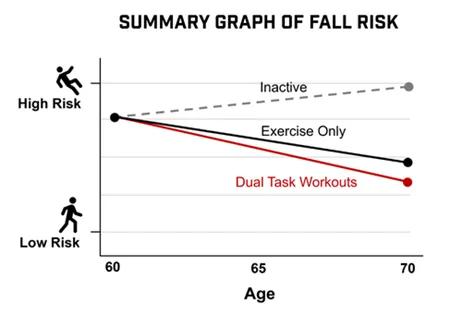
Executive functions are the brain systems that support planning, attention and decision making. With advanced age, these systems often slow and become less efficient, making everyday tasks feel more challenging.1 Declines in executive functions are associated with slower reaction times and higher fall risk.2,3 While treatment options are limited for regaining executive functions, physical activity remains one of the most reliable ways to support these brain systems. Evidence also indicates that exercise can be even more beneficial for enhancing stability with dual tasking workouts.

Dual Task Training

Dual tasking occurs when a physical demand is paired with a cognitive challenge, such as walking while solving problems or indoor cycling while engaging with a virtual screen-based experience. Daily life routinely requires the brain to rely on simultaneous motor and cognitive control, for instance, navigating a crowded room, carrying on a conversation while walking, or responding to unexpected obstacles. Training with a combination of physical and mental effort seems to better prepare the brain and body for these real-world demands, even more than exercise alone.4
Research Emphasizes Cognitive Engagement

Recent studies in aging and fall prevention have shifted away from asking whether exercise helps to how to make the training even more engaging, sustainable and effective. Many studies test the outcomes of interactive walking tasks, exergames and attention-based challenges. The goal is not cognitive overload, but repeated practice of attention shifting, inhibition during coordinated movement. The added benefit of dual tasking vs exercise alone is typically modest but consistent, with small to moderate gains in executive function and clearer improvements in gait stability.4,5

Expert perspectives on the future of dual tasking

The research on dual tasking is highly relevant to fitness professionals who serve older adults, and research is continuing to explore how to make these workouts more engaging and effective.

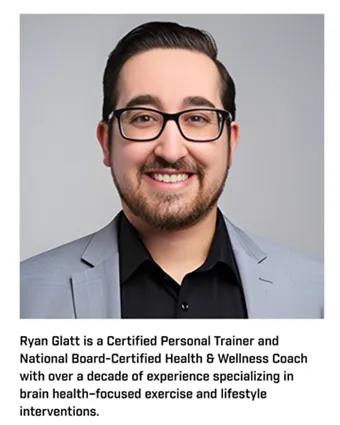
Ryan Glatt, PhD(c), MS, ACE-MES, NBC-HWC, Director of the FitBrain Program at Pacific Neuroscience Institute, emphasizes that the true value of dual task training lies in how closely it mirrors real life.
“What excites me most about dual task training is its practicality and the incorporation of cognitive tasks with movement to increase engagement,” says Glatt. “In daily life, we rarely move without thinking. We walk while planning, reacting, scanning our environment, or carrying on a conversation, which in older adults may increase the risk of falls. Dual-task training may better reflect real-world demands. When movement is paired with cognitive-domain specific demands (e.g. memory, attention) we���re training the brain and body together in a way that feels purposeful. At the very least, there is a greater level of enjoyment and variety within a training program. If the application and dosage is significant and relevant, we may improve cognition, and not just achieve the physical goals that our industry is accustomed to addressing, which are very meaningful and impactful.”

“Even participation in any cognitively-demanding or open-skill activities and neuromotor modality is beneficial, which improves cognitive and motor function in a variety of populations,” he explains. “From a coaching and clinical perspective, enjoyment and adherence matter just as much as effect size. If people enjoy the training and stick with it, that’s where long-term benefits can emerge.”

Drawing from his clinical and research work in exergaming and cognitively engaged exercise, Glatt adds that technology can lower barriers to participation by making dual task training more accessible, scalable, and engaging for older adults.

Why This Matters for Fitness Professionals

From a practical standpoint, dual task training is not about turning workouts into cognitive tests. Instead, it’s a strategy that helps older adults practice using more of their brain while moving. When coordination and attention are trained together, movement becomes safer and clients become more confident. Even small gains in stability or reaction time can matter for older adults who prioritize independence.

Applying Dual Task Principles in Facilities

Many cardio consoles already provide natural dual task conditions by pairing rhythmic movement with cognitively engaging content. Card games, reading or visually guided interaction place light demands on attention and memory, while the treadmill, indoor cycle or elliptical challenge coordination and balance. With minimal staff instruction, these experiences can move beyond entertainment and become intentional training tools.

For operators, this creates an opportunity to offer more than exercise alone. As the population ages, more adults seek programs that help them stay independent. Their goals and expectations shift toward facilities that protect longevity and independence, so facilities that intentionally support these experiences will be better at meeting their needs.